Turbulence forecast for your flight
Know what your flight will feel like. A free turbulence outlook for your route, explained in plain words. Then a calm co-pilot in your pocket for the flight itself.
Check your route
A calm co-pilot in your pocket
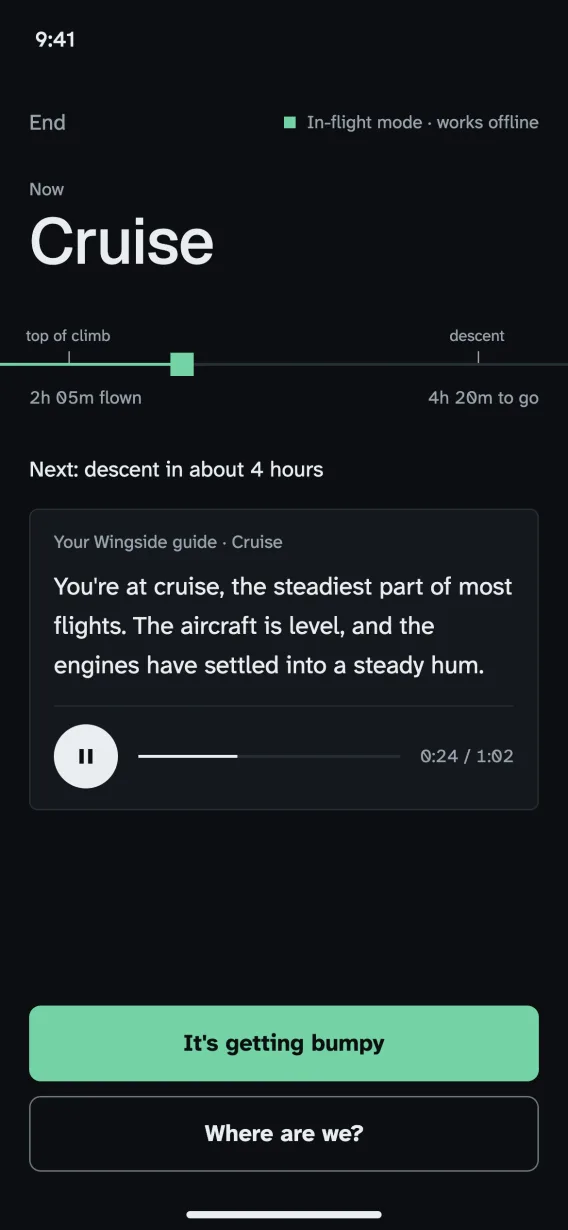
Wingside talks you through each stage of the flight, explains every sound and bump as it happens, and works offline in the air.
Coming soon to the App Store
How it works
Add your flight
Your flight number or your airports and time. The app gets you ready the night before.
Hear what to expect
A turbulence outlook in plain words, and what each stage of the flight will sound and feel like.
Fly with a calm guide in your pocket
Your Wingside guide talks you through each stage, offline, from the gate to landing.
Turbulence forecast questions
What is a turbulence forecast?
A turbulence forecast shows where bumpy air is likely along a route and at what height. Wingside reads the Graphical Turbulence Guidance forecast and pilot reports that NOAA publishes, follows your route at cruising height, and tells you in plain words where you may feel bumps and for how long.
How far ahead can I check my flight?
Your turbulence outlook appears about 16 hours before departure, when the forecast reaches your flight. Until then, the route pages explain what bumps are usual on that route.
Which flights does it cover?
Flights that start or end in the United States, over the area NOAA forecasts. For other routes, the Wingside app still guides you through every stage of the flight.
Is the turbulence forecast free?
Yes. Checking a route here is free, with no account. The Wingside iPhone app adds the outlook for your saved flights and a calm guide for the flight itself.
Is turbulence dangerous?
For a passenger with the seatbelt fastened, turbulence is uncomfortable but not dangerous. Airliners are built for far stronger loads than turbulence brings, and pilots slow down and change height to find smoother air.
Popular routes
- New York to London (JFK–LHR)
- London to New York (LHR–JFK)
- Los Angeles to New York (LAX–JFK)
- New York to Los Angeles (JFK–LAX)
- Chicago to New York (ORD–LGA)
- New York to Chicago (LGA–ORD)
- Los Angeles to San Francisco (LAX–SFO)
- Atlanta to Orlando (ATL–MCO)
- San Francisco to Los Angeles (SFO–LAX)
- Orlando to Atlanta (MCO–ATL)
- Las Vegas to Los Angeles (LAS–LAX)
- Denver to Phoenix (DEN–PHX)